Wednesday, May 5, 2010

Honeycomb Rocks - Dixie National Forest, Utah

Our plan was to camp for a night or two at Honeycomb Rocks, but like all plans, this one went awry, but in a very pleasant way. The campground was closed. Like many National
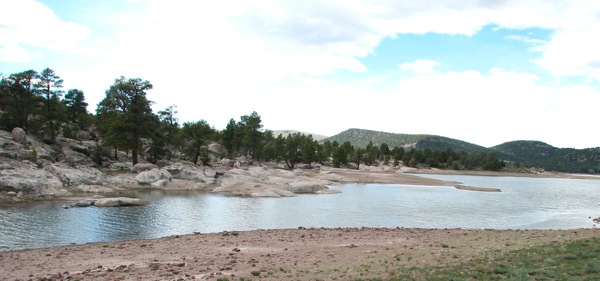
Forest areas there is dispersed camping allowed throughout the forest away from the campgrounds. The forest service road continued on by the campground, and so did we. About a quarter mile away the road climbed up a ridge to overlook the Upper Enterprise Reservoir.
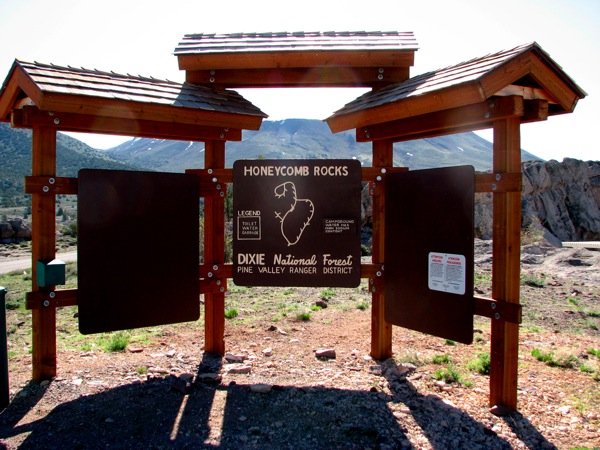
Honeycomb sign

It was Saturday and there was a full complement of rigs along the ridge getting ready to party so we continued along the road until it forded the inlet to the reservoir (we're so glad at times like this that we have a 4 wheel drive truck camper) and crossed to the other side of the lake and set up camp. It was early afternoon and shortly the shootin', hollerin' and rap music started up across the lake...and you know how well sound can carry across a lake. We did a little exploring and found that the lake was horseshoe shaped and the prettiest part of the lake lay behind another ridge that only a vehicle like ours could access.

Pack up the TC, raise the jacks, lock in the 4 wheel drive, up and over the ridge to the nicest little, serene, quiet, spot, right on the lake shore.

Honeycomb campsite
We set up camp and were met by the local greeters. We think these are dowitchers.
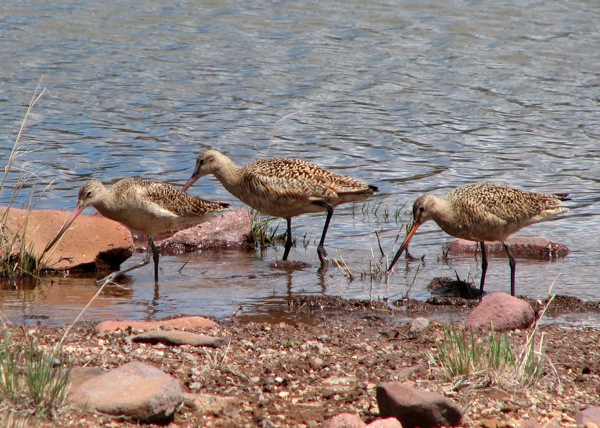
Greeters at campsite
We had escaped the Saturday night yahoos on the other side of the lake, but had no shortage of visitors for the rest of our stay here.
Visitors
A small group of 7 mule deer visited us most evenings and every morning.

Look closely swallows
There had been a very recent hatching of some kind of insect, (non-biting) that had the local cliff swallows in a feeding frenzy. The picture above illustrates how hard it is to capture a cliff swallow in full dive, but you get the picture.
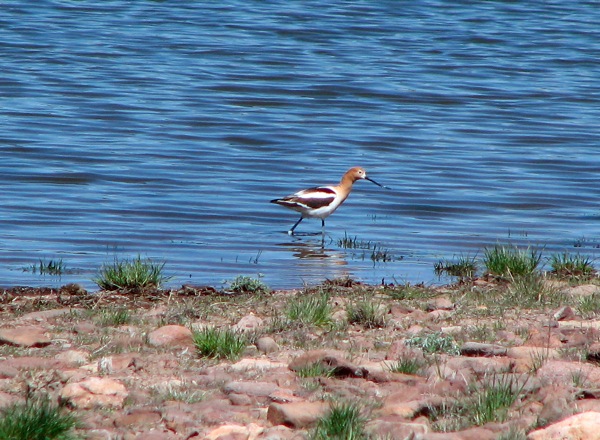
American AvocetCheryl also caught (with her camera of course) an American Avocet fishing in the lake.

The first night we took a walk to find out what these honeycomb rocks were all about. It turns out that the rocks in the area are volcanic tuff, which is a light porous rock created by compression of volcanic ash over millions of years. They are scattered about the area in bits and pieces and also make up the canyons, ledges and plateaus that surround the lake.
Honeycomb rocks 
Honeycomb
Here's a picture of the namesake honeycomb.


Honeycomb playground

It was beautiful on the lake, but we were exposed to the wind out there and the prediction was for more and greater winds over the next few days.

Tucked in the honeycomb
We elected to move a few hundred feet to a more sheltered spot.  The new spot provided us with a good place to do a load of laundry.
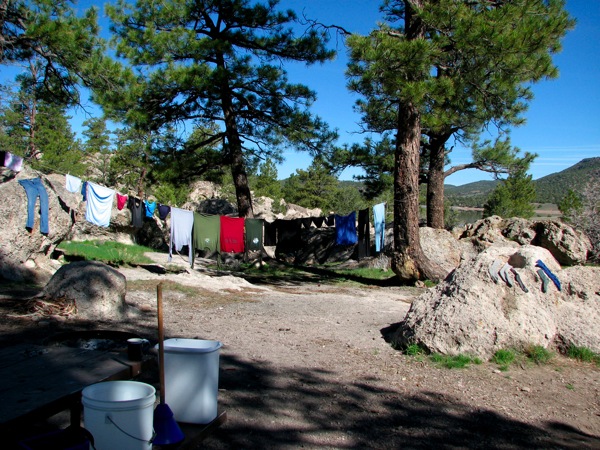
Laundry day at Honeycomb

Traveling as we do for months at a time, laundry becomes an issue. We can, and do, go to laundromats, but it is often easier to just do a small wash in a 5 gallon bucket and hang it out to dry. We have our “Emergency Essentials” Bucket Washer (I'll post a picture sometime), our patented 4 hands wringer, and here in the west, between the dry air and the almost constant wind, the clothes are ready in a very short time.

It was still a peaceful scene, near the small inlet on the edge of the lake, and we were much less bothered by the wind, and we still had our visitors every morning.


Our little deer
We had the usual visits from Vultures. Cheryl calls it the beautiful flight of the ugly bird.
Beautiful flight of ugly bird


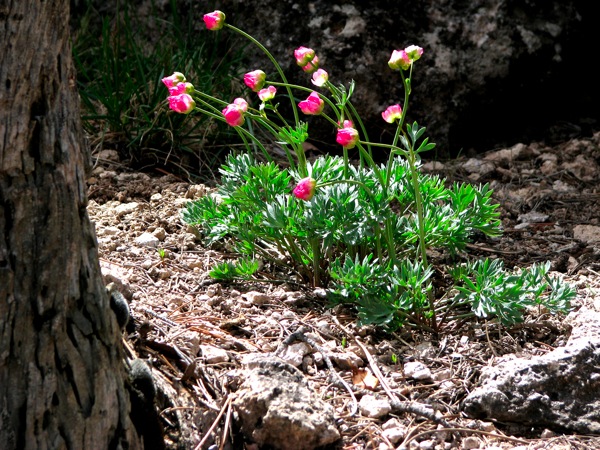
In the midst of grays and browns PINK
The desert is starting to come alive with flowers and we hope to be seeing many more in the coming weeks as we head east, through Kanab, and into the Paria river area, just west of Lake Powell and the Glen Canyon Dam.

Sunday, May 2, 2010

Cathedral Gorge State Park, Nevada

11 cathedrals and campground


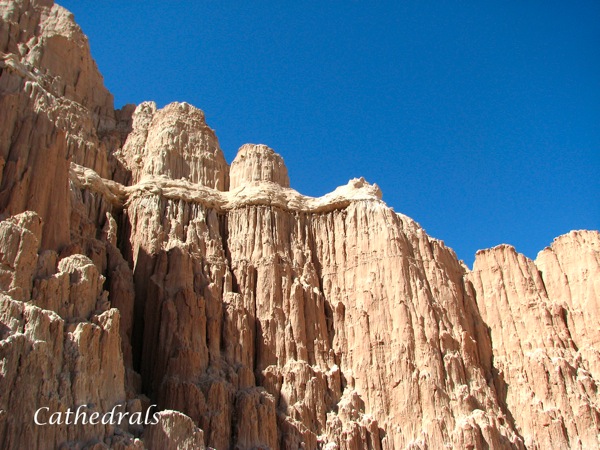
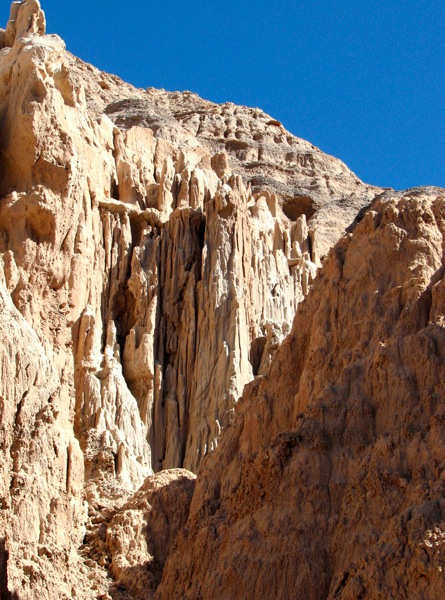
Cathedral Gorge State Park is located about 200 miles north of Las Vegas near Pioche, NV. This small park is noted for it's fantastically shaped rocks and caves. The rocks, similar in look to the badlands of South Dakota, do remind one of cathedrals.

01 cathedrals
03 weathered textures

The texture of the rock varies from smooth to very roughly eroded and weathered. Some of the rock was as hard as, well, rock, and some was soft and crumbly, almost the consistency of dried mud. As you can see here, and in the following picture, the erosion, caused by water in this case, sometimes comes from within the rock creating hollows, caves, and narrow canyons.
 
02 Layers and depths
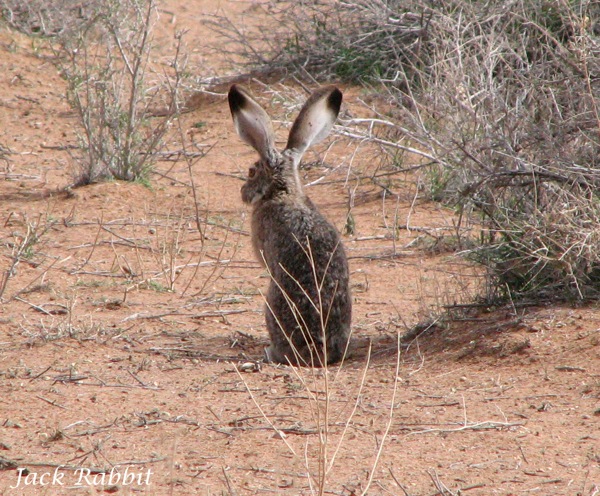
The only wildlife we saw was Jack Rabbits, which are actually Hares.05 Jack Rabbit


08 a Hare reallyI have no idea what the difference is between a rabbit and a hare, If anyone knows, post me a comment and I'll share it with everyone in the next letter.

We only stayed here one night, but were impressed by the place and spent about 5 or 6 hours hiking and exploring the various features of the park.

09 old water tower
We took a hike starting at this old water tower built in the 1930s by the CCC (Civilian Conservation Corp). The CCC was a program to put young men to work during the depression while improving the facilities at national, regional, and state parks. The CCC parks are all around the country and you can usually tell when you are in a CCC built park by the quality of the workmanship and the well thought out layout of the campgrounds and trails.

04 eroded spires
Note the debris paths below these spires. In this picture the debris is chips and pieces of rock probably due to freeze cycle weathering. In others you will see sand or mud trails from wind or water erosion. Nature never seems to want to stop tearing down what it has built up.


06 Inside the caves
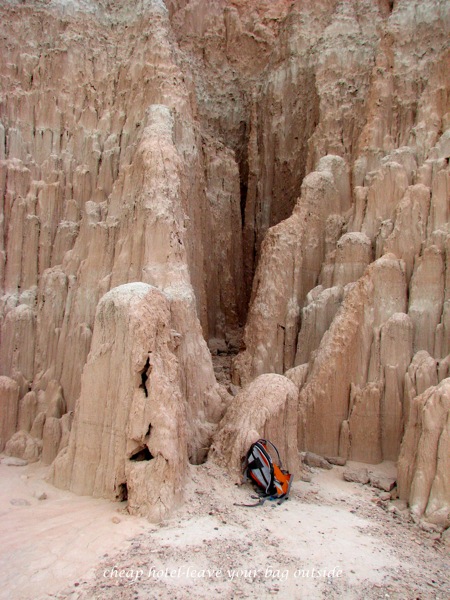
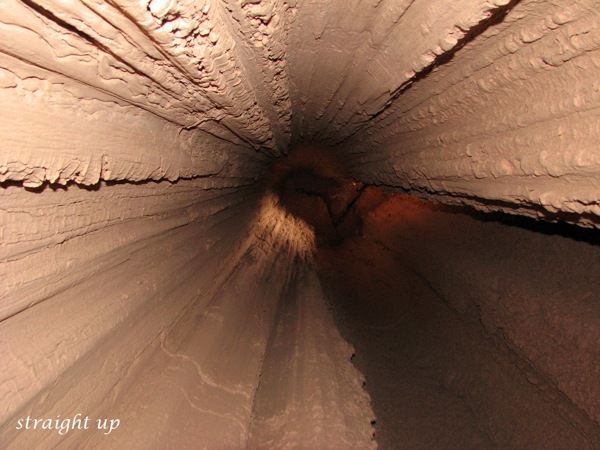
The caves were sometimes 100 to 150 feet deep, 80 to 100 feet high, and barely wide enough to squeeze through. They were like miniature slot canyons. We often had to leave our packs on the trail outside the cave in order to fit.
15 cheap hotel leave bag outside 

12 tight fit 


14 straight upSome caves were open to the sky at the top, some like this one were closed off by a thin cap of more erosion resistant rock.

You can see a band of more erosion resistant (harder) rock running through this group below and you can see caprocks of the same material on top of some of the spires. The caps are formed when the softer rock underneath erodes away. Eventually the caps will fall.


19 caves and rugged towers  

16 across the canyon floor
18 canyon cave
17 amazing place

Next we will head SouthEast to the Paria River Area.

Saturday, May 1, 2010

The Eastern Sierra Nevada Mountains - California


Our approach to the Sierras was from the East. We crossed the White Mountains at Mongomery Pass and descended into the Owens Valley north of Bishop California.

Mural in downtown Bishop.
After a quick stop by the "Produce Police" in Benton, forcing us to eat or discard our citrus before proceeding, we made our way south to Bishop. Bishop California is a great little mountain town reminiscent of places like Whitefish Montana, North Conway New Hampshire, and Jackson Hole Wyoming before the great migration. Sure, it's busy and it has a "strip" , but it also has that feel that the people who live and visit here come for the mountains. Main Street has lots of coffee shops, a few bars, and plenty of outfitters.
The Inyo National Forest, in the Eastern Sierra mountain range, lies immediately to the west of Bishop. Many of the Forest Service campgrounds were still closed but Bishop Park, at 8,000 feet, and right up there in the high peaks, was open. You have to love a campsite with mountain sunrises and sunsets, deer wandering through the campground, easy access to hiking and a 15 minute drive from Bishop.


For sheer rugged beauty it's hard to beat the Sierras. Weather at this time of year varies from 80℉ daytime temperatures to 20℉ at night, bright sun to snow. that's just about perfect weather for us.


Red Cedar at Rock Creek
Convict Lake, one of the few that were free of ice at this time of year.

Friday, April 30, 2010

The Murals of Ely, Nevada

It's funny how when you're traveling around you sometimes find things you're not looking for. We left Ruby Lake National Wildlife Refuge badly in need of laundry. Checking with Lois, our trusty (mostly) GPS, we found a laundromat, right on Main Street, in Ely Nevada. Who knew? Ely is famous for it's murals. Herewith are a few.
Charcoal oven muralThe Ward Charcoal Ovens. The ovens, built in the 1870s manufactured high grade charcoal for the silver smelters at Ward, just south of Ely.

Pony ExpressCelebrating the Pony Express.

When we left the laundromat we drove south a few miles to a BLM (Bureau of Land Management) elk viewing site. It was nice, free, camping was allowed, and secure, as it was the hiding spot for the local police speed enforcement zone. We woke to an inch of blowing snow and rather than face the pass to our south, we drove back north to Ely to let the day warm and catch some more of the murals. By the way we did view elk, as well as pronghorns, and a badger.

Busty in barroom
Barrooms and casinos seem to be the major industry of Ely, so this seems appropriate.


Seriously, Ely seems a bit depressed like much of the nation we have seen, but it looks like it could be a fun town to visit. The town is a typical Main Street western town, surrounded by gorgeous mountains, still snow capped here in early May.
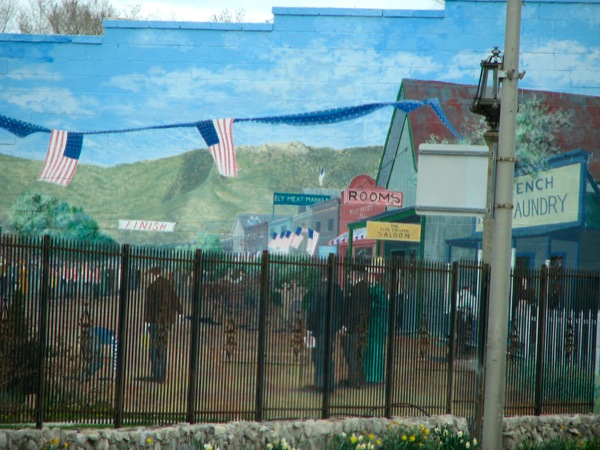
Through the fenceLooking at this picture later in the day, after braving the pass, we couldn't tell if the fence was in front of the mural or part of the mural. We'll have to check next time through.


Sneaking a peak at the headlines


I decided to sneak a peak at the headlines while we were in town. Unfortunately, they were for 1934. Mostly about politics and the bad economy...stuff like that.


Other end of locomotive mural
Click on the picture for a larger view.
Locomotive
Click on the picture for a larger view.
This mural seems to celebrate the various modes of transportation that passed through Ely in the old days, showing the wagon trains, the horse drawn stages, the cattle drives and finally the arrival of the locomotive which certainly did much to change the west (the mural was so big we had to take it in two pictures).


We will head south now with a stop at Cathedral Gorge State Park.

Wednesday, April 21, 2010

Ruby Marsh National Wildlife Refuge, Nevada


National Wildlife Refuge

This one picture says it all about Ruby Marsh, a place of big mountains, big valleys, and big sky. This wildlife refuge, located in Northern Nevada at the meeting of the Great Basin and the northern mountains, reminds one of what America must have been like a million years ago. After another 28 mile gravel road (this one a little dryer than the road to City of Rocks) we arrived at the Ruby Marsh National Forest Campground.

Camper and canyon from marsh
If you look real closely, right below the opening into the canyon, you will see our camper all alone in the campground. The campground is technically open this time or year, but facilities are limited with no water or bathrooms. Fortunately not a problem for us. The weather as is typical for spring is changeable by the hour and we received the usual gamut.

Storm brewing

Remember that canyon from the picture on page 2? Well we decided that we wanted to hike up to those snowfields. We had no topographic maps of the area, there is no trail, but it was so tempting...so off we went.

Hiking the ravine
Overview
The higher we got, the rougher the trail got, but the better the views got.  How high should we go? Finally we let exhaustion determine the limit.

We didn't make it to the snow fields. We reckon we hiked 5 miles what with dead ends and side trips. Every turn in the canyon gave us a better view of the Refuge, and another corner or two ahead.
Refuge from high in the canyon

Shantytown
The park brochure mentioned supplies being available at “Shantytown” 2 miles down the road so we took the truck down to take a look. Unfortunately “Shanytown” seems to be closed for the season. Good thing we were well stocked.  Note that there is still plenty of snow at the higher elevations, The Ruby Mountains are one of the premier Heli-Skiing operations in the west.

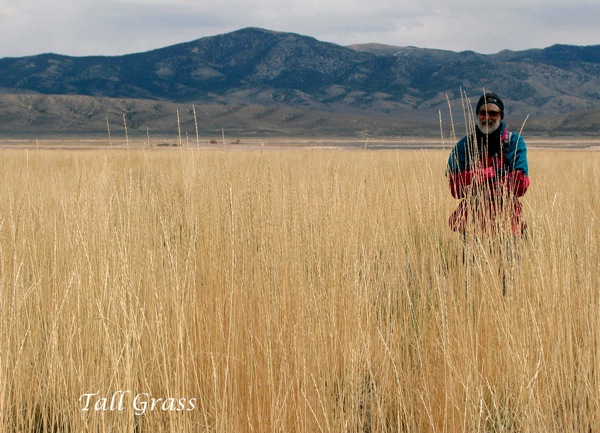
On our last day at Ruby Marsh we took a hike out into the marsh. The marsh contains vast areas of birds, sagebrush, marshy wetlands, and tallgrass prairie.
Tall grass

They run rampant if you don t cage them

There's lots of wildlife in the refuge. We saw mule deer, rabbits, ground squirrels, but didn't see coyotes or bobcats, both of which are present. The birdlife is amazing, but they are very skittish and hard to photograph.
White faced Ibis and friend
Besides these two we saw Kestrels, Redtail Hawks, Northern Harriers, Trumpeter Swans, many types of geese and ducks, and the ubiquitous Vultures.

Next we head to Ely, NV which is famous for, among other things, murals.  Leaving Ruby Marsh via a (you guessed it!) 28 mile gravel road.  Must be a numerology thing.